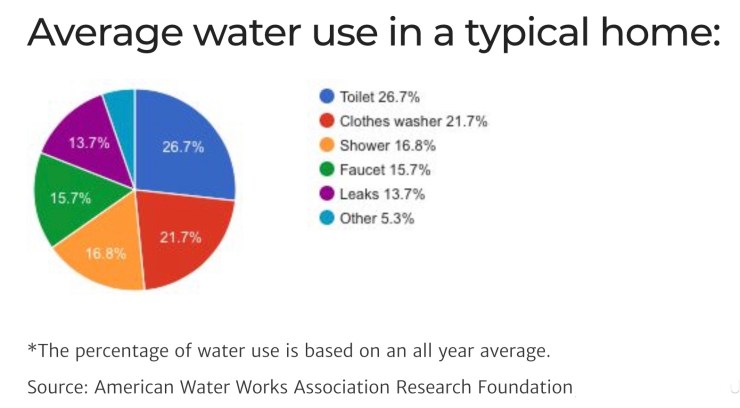
With the ever increasing water and delivery charges from our Regional Water Authority it would be wise for everyone to be thinking of methods to conserve water. While the HOA is considering and implementing methods to conserve irrigation water it is important to look at water conservation inside of the home. Please read the following water facts and information and consider how you can make a difference. This chart shows the average percentage of water usage in different areas of the home.
What can you do inside of your home?
Check all the faucets inside and outside of your home for any that drip. The fix could be as simple as a ¼ turn with a wrench.
Consider using low-flow aerators on your faucets. They can reduce water usage from 1.5 GPM to .5 GMP without a noticeable difference to you and can be purchased on Amazon for less than $2.00 each.
Check your toilets for leaks! First, let me say that a severely leaking toilet can waste up to 200 gallons of water in a 24 hour period. Second, it’s probably driving you crazy every night as you try to go to sleep. The fix is usually as simple as a new toilet kit from any big box home improvement store for around $15.00.
Only wash partial loads of clothes and dishes when absolutely necessary. Wash when full. When it’s time to replace old appliances consider water saving models.
Irrigation and outside of the home.
With the install of the Smart Meter we can now see that last year one cycle of the irrigation system for the neighborhood used approximately 10,000 gallons of water. As of now, you can expect this year’s watering schedule to be the same in frequency but less in duration. This is for several reasons. 1) Yards can only hold a certain amount of water, after that saturation point it’s just run-off into the street and down the drain. 2) Over watering weakens the turf root system. 3.) Once the saturation level goes beyond the bottom on the turf root system it does no good.
What can you do outside of your home?
Don’t supplement the irrigation system by over watering your grass. Do not under any circumstances turn on your sprinkler and leave for the day. All of your neighbors will know that you’re wasting water.
Supplementing the water in your flower beds is an acceptable practice when using a low-flow sprinkler or a soaker hose. These get the most coverage with the least amount of water use. It is highly suggested that you use an inexpensive hose timer and set up a schedule that works with irrigation schedule.
Once the irrigation schedule is determined it will be posted in the ALERTS section.
In general, with the new Smart Meter we can better manage our usage and are notified of any leaks that increase water flow over 40 gallons per hour. If you see a leak anywhere in the neighborhood please report it using the contact tab or call any board member.
 Champions Colony III